
From nucleotide reads to protein-level insights.
Translate sequencing reads into amino acid sequences, identify distinct proteins and quantify their abundance.
- MAW40%
- MKT25%
- GLA15%
Illustrative example. It is not a real project result or output from the production platform.
A bioinformatics platform for translating nucleotide sequences (DNA and RNA) into their corresponding amino acid sequences, with specialized applications in antibody and protein sequence analysis.
Supporting research in molecular biology, immunology, biotechnology and drug discovery.
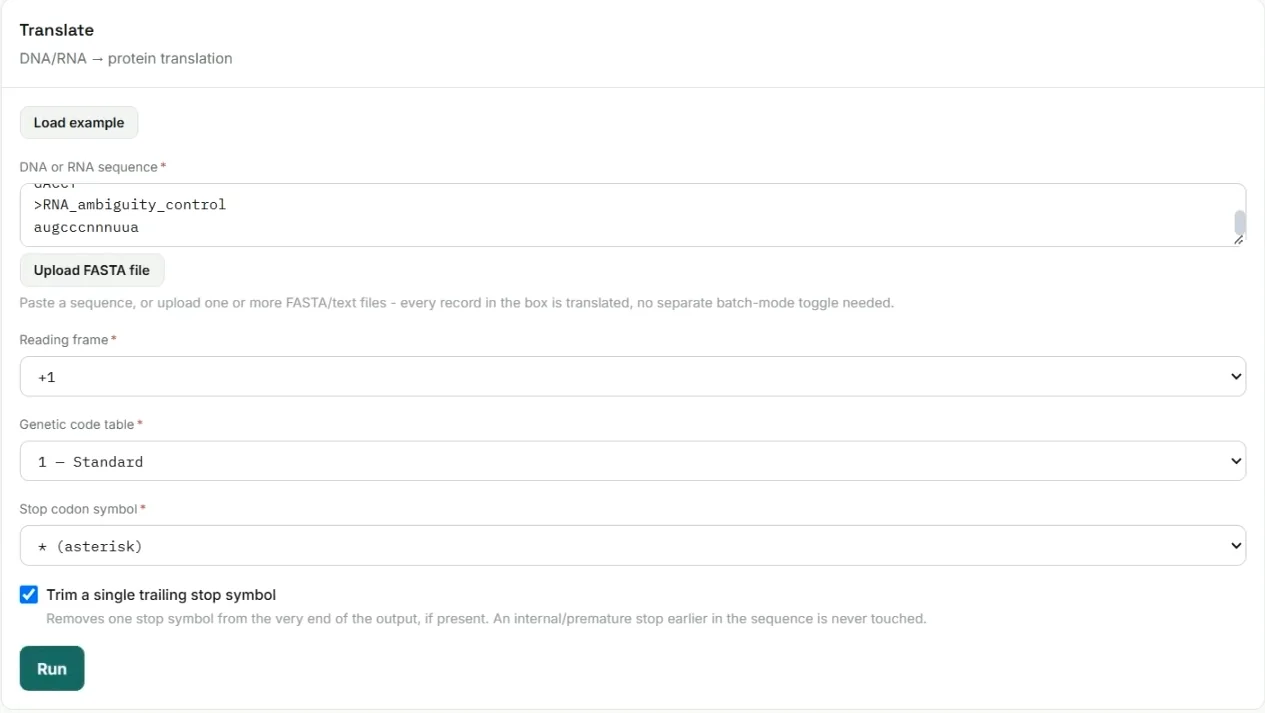
- A · Sequence input
Start with your sequences
Paste DNA or RNA, or upload one or more FASTA or text files. Every record in the box is translated, with no separate batch mode. A sample can be loaded to try it.
- DNA or RNA, as text or FASTA files
- Several records at once
- B · Translation settings
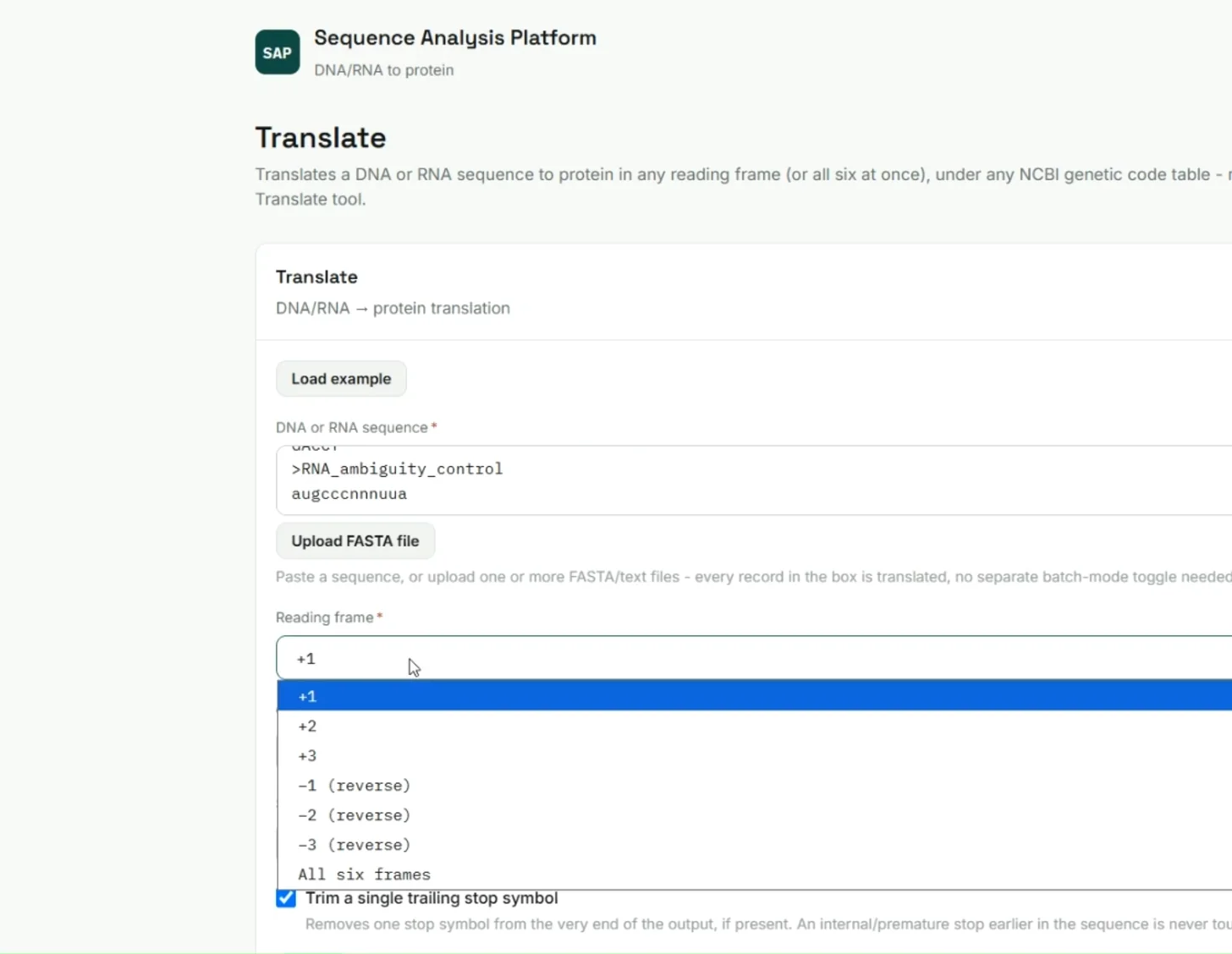
Choose a reading frame
Translate one frame, forward or reverse, or all six frames at once.
- +1, +2, +3
- −1, −2, −3 (reverse)
- All six frames
- B · Translation settings
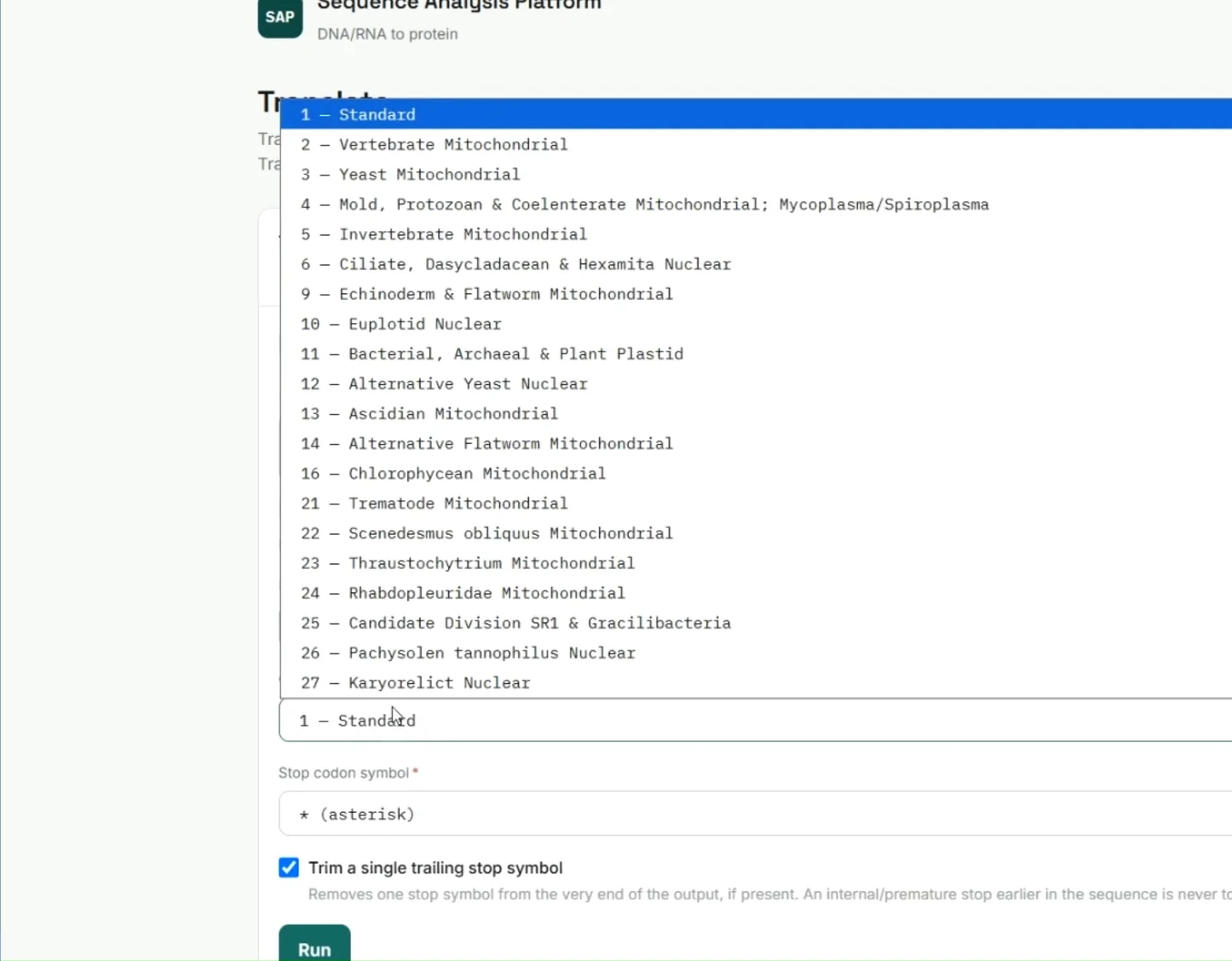
Pick a genetic code
Select an NCBI genetic code table. Standard (table 1) is the default, and mitochondrial, bacterial, yeast and other codes are available.
- Standard code by default
- Organism-specific tables
- B · Translation settings
Decide how stops are shown
Show stop codons as an asterisk, a period or X, and optionally trim a single trailing stop. An internal stop earlier in the sequence is never touched. Then run.
- Stop symbol: * . or X
- Trim one trailing stop
- B · Translation settings
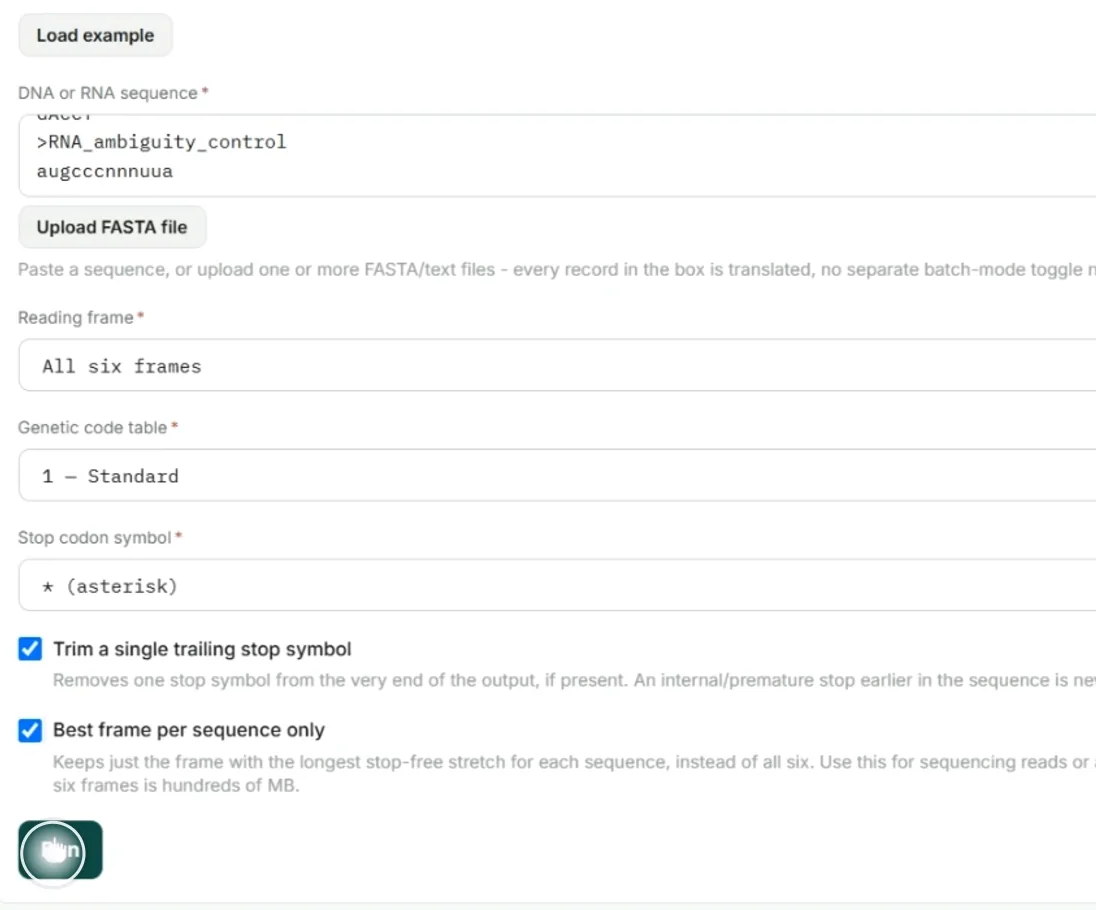
Keep the best frame per sequence
When translating all six frames, keep only the frame with the longest stop-free stretch for each sequence. This suits sequencing reads, where six frames of a large dataset would be very large.
- Longest stop-free stretch wins
- Keeps output manageable
- C · Results
Read the run summary
See the genetic code, number of records, input bases and frames, plus warnings such as trailing bases that were ignored or ambiguous codons.
- Genetic code, records, bases and frames
- Warnings explained, not hidden
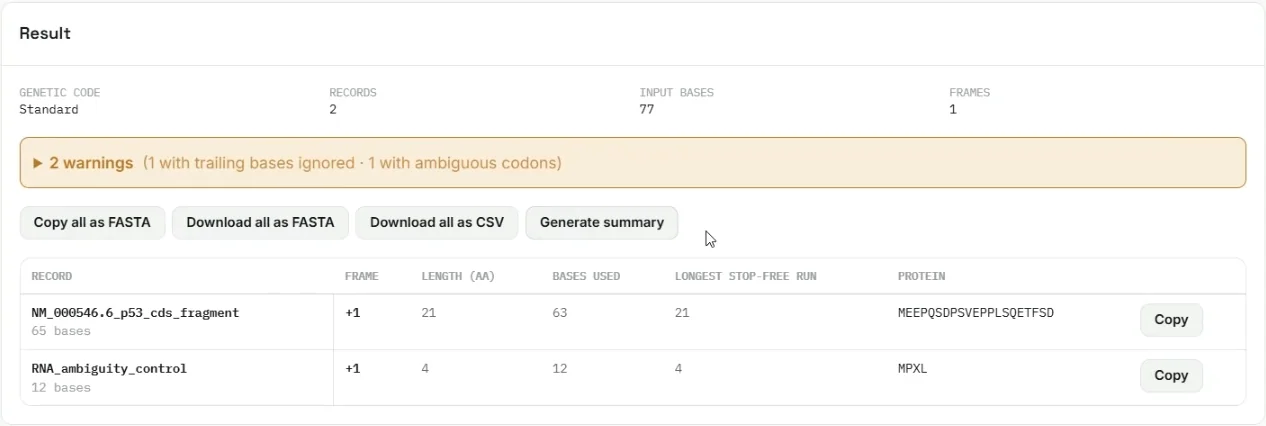
- C · Results
Inspect and export each translation
A per-record table shows frame, length in amino acids, bases used, the longest stop-free run and the protein. Copy or download as FASTA or CSV.
- Record, frame, length and protein
- Copy as FASTA, download FASTA or CSV
From reads to protein-level summaries
Translations and their summaries can be copied or downloaded as FASTA and CSV. AbProSAP translates and summarises sequence data; it does not predict binding, structure or efficacy.
Try a reading frame
Choose a frame, then select a codon to see how it becomes an amino acid.
- Translation
- MAW*
- Trailing bases
- None.
- Selected codon
- Select a codon above.
A terminal stop (*) is shown here. The platform trims one terminal stop by default and keeps internal stops. Changing the frame shifts where codons begin, so the same read can give a completely different protein.
Illustrative demonstration with the Standard genetic code only. It runs in your browser and does not call the AbProSAP platform.
From reads to protein frequency
One illustrative dataset drives every view below.
| Protein | Length (aa) | Absolute frequency | Relative frequency |
|---|---|---|---|
| MAW | 3 | 40 | 40% |
| MKT | 3 | 25 | 25% |
| GLA | 3 | 15 | 15% |
| MAWGK | 5 | 12 | 12% |
| MKTAVL | 6 | 8 | 8% |
| Counted translations | 100 | 100% |
- Absolute frequency
- The number of counted translations that match a protein.
- Relative frequency
- Absolute frequency divided by all counted translations, times 100. Excluded translations are not in the denominator.
- Distinct proteins
- The number of unique amino acid sequences after grouping (5 here).
Illustrative example data — not a real project result.
Turn sequencing reads into interpretable protein-level summaries.
Tell us about your sequencing data and research objectives. Our team can discuss the appropriate analysis workflow and its suitability for your project.